Feb 10, 2017

[paper] Model for Organic Thin-Film Transistor

Physically Based Compact Mobility Model for Organic Thin-Film Transistor
T. K. Maiti, L. Chen, H. Zenitani, H. Miyamoto, M. Miura-Mattausch and H. J. Mattausch
in IEEE Transactions on Electron Devices, vol. 63, no. 5, pp. 2057-2065, May 2016.
doi: 10.1109/TED.2016.2540653

Abstract: A physically based compact mobility model for organic thin-film transistors (OTFTs) with an analysis of bias-dependent Fermi-energy (EF) movement in the bandgap (Eg) is presented. Mobility in the localized and extended energy states predicts the drain-current behavior in the weak and strong accumulation operations of OTFTs, respectively. A hopping mobility model as a function of the surface potential is developed to describe the carrier transport through localized energy states located inside Eg. The Poole-Frenkel parallel-field-effect mobility and vertical-field-effect mobility are considered to interpret the bandlike carrier transport in the extended energy states. The parallel field effect on mobility is more pronounced for shorter channel length OTFTs and is considered by developing a channel-length-dependent mobility model. The vertical field effect on mobility is included to account for the effect of mobility on carrier transport at high gate-voltage-induced fields. We also compared the model results with 2-D device simulations and measurements to verify the developed mobility model [read more...]

Workshop on biomedical applications at EPFL Lausanne

Data communication and remote powering for biomedical applications 
Workshop organized by Prof. Catherine Dehollain and Dr. Maria-Alexandra Paun
on February 24, 2017 at 09:00-17:00 in Room BC 01, EPFL Lausanne

Workshop Program
Time
Invited Speaker
Presentation Title
09:00-09:35
Professor Catherine DEHOLLAIN,
EPFL, Lausanne, RF IC group
“Remotely powered sensor networks for medical applications”
09:35-10:10
Dr. Maria-Alexandra PAUN, EPFL, Lausanne, RF IC group
“Modeling and analysis of antennas in cochlear implants”
10:10-10:45
Dr. Gürkan YILMAZ, EPFL, Lausanne, RF IC group
“Wireless Power Transfer and Data Communication for Intracranial Neural Implants. Case Study: Epilepsy Monitoring”
Coffee Break (30 minutes)
11:15-11:50
Dr. Mehrdad GHANAD,
EPFL, Lausanne, RF IC group
“Remotely-Powered Batteryless Implantable Local Temperature Monitoring System for Freely Moving Mice”
11:50-12:25
Francesca STRADOLINI,
EPFL, Lausanne, LSI laboratory
“On-line monitoring of aesthetics during surgery: opportunities and challenges”
12:25-13:00
Professor Adrian M. IONESCU, EPFL, Lausanne, Nanolab laboratory
“Wearable biosensors and their applications in future digital health”
LUNCH (90 minutes)
14:30-15:05
Dr. Wladek GRABINSKI,
MOS-AK Association (EU)
“FOSS TCAD/EDA simulation tools with molecular/bio/med modeling examples”
15:05-15:40
Dr. Albrecht LEPPLE-WIENHUES,
Valtronic Technologies SA
“Ear infection, drug injectors and blood donation: innovative medical device development”
15:40-16:15
Dr. Qing WANG,
CHUV, Lausanne
“Development of a flow-through telemetry implant for monitoring cardiovascular blood pressure in small rodents and human”
16:15-16:50
Professor Philippe RYVLIN, CHUV, Lausanne
“Wearable devices for neurological diseases: Towards more rigorous clinical evaluation”
Concluding remarks (10 minutes)


Feb 9, 2017

[paper] RF-MEMS for Future Mobile Applications: Experimental Verification of a Reconfigurable 8-Bit Power Attenuator up to 110 GHz

RF-MEMS for Future Mobile Applications: Experimental Verification of a Reconfigurable 8-Bit Power Attenuator up to 110 GHz
Jacopo Iannacci1 and Christian Tschoban2
1Center for Materials and Microsystems - CMM, Fondazione Bruno Kessler , Trento, ITALY
2Fraunhofer Institut für Zuverlässigkeit und Mikrointegration IZM , Berlin, GERMANY
Journal of Micromechanics and Microengineering
Accepted Manuscript online 8 February 2017
Abstract
RF-MEMS technology is indicated as a key enabling solution to realise the high-performance and highly-reconfigurable passive components that future 5G communication standards will demand for. In this work, we present, test and discuss a novel design concept of an 8-bit reconfigurable power attenuator manufactured in the RF-MEMS technology available at the CMM-FBK, in Italy. The device features electrostatically controlled MEMS ohmic switches, in order to select/deselect resistive loads (both in series and shunt configuration) that attenuate the RF signal, and comprises 8 cascaded stages (i.e. 8-bit), thus implementing 256 different network configurations. Fabricated samples are measured (S-parameters) from 10 MHz to 110 GHz in a wide range of different configurations, and modelled/simulated in Ansys HFSS. The device exhibits attenuation levels (S21) in the range from -10 dB to -60 dB, up to 110 GHz. In particular, the S21 shows flatness from 15 dB down to 3-5 dB, from 10 MHz to 50 GHz, while less linear traces up to 110 GHz. Comprehensive discussion is developed around the Voltage Standing Wave Ratio (VSWR), employed as quality indicator for the attenuation levels. Margins of improvement at design level are also discussed, in order to overcome the limitations of the presented RF-MEMS device. The results of S-parameter simulations performed in the Quite Universal Circuit Simulator (QUCS: qucs.sourceforge.net) for a few significant configurations of the RF-MEMS attenuator from 10MHz to 110GHz are reported, too. [read more...]

[SemiWiki] What are the future technology trend for SPICE Modeling?

CEO Interview: Albert Li of Platform Design Automation, Inc (PDA)
by Daniel Nenni Published on 11-27-2016 02:00 PM

[SemiWiki] What are the future technology trend for SPICE Modeling?
[PDA] Having sufficient data is really the key to the problem, if data is sufficient, model can be automatically generated or synthesized. The concept has already been applied to the case of passive device modeling, such as modeling inductors. EM solvers play the role of proving more “data” or the synthesizers to generate models automatically. We’ve been working with the same concept for the active devices for quite a while, one way is to enable faster measurements, so that a lot more data can be collected and the other way is to achieve huge amount of data based on limited silicon through machine learning, which requires deep understanding of device behaviors, device modeling knowledge, data for the training and years of training experiences, we have already successfully applied the methodologies to our service projects, and tedious tasks such as model re-targeting is now purely done by machines. Machine Learning enabled model targeting from tweaking model parameters to just defining the targets and let the machine finish the job automatically

[SemiWiki] What are other areas in semiconductor you see that Machine Learning can help?
[PDA] We’ve published 3 papers in the past few years related to machine learning, and we used machine-learning algorithms to help on speeding up soft error simulation of logic circuits, automatic statistical modeling, and automatic RF front-end design,so the areas of machine-learning applications are massive. Algorithms, expertise, data and risk are the four key components to access Machine-Learning applications, take device characterization and modeling as examples, we have been working on the machine learning algorithms for over a decade, and we are definitely the experts in device characterization and modeling, we also have huge amount of data and models from previous projects, and these enabled us to train our software or instrument to achieve faster measurements and automatic model generations. 

[Book] Low-power HF Microelectronics: a unified approach

Low-power HF Microelectronics: a unified approach 
ISBN: 9780852968741 e-ISBN: 9781849193610
Editor: Gerson A. S. Machado
Department of Electronic Engineering
Imperial College of Science, Technology and Medicine
London, UK
Front Matter
1 Low-power HF microelectronics: a unified approach
Part 1: Process technology
2 Device structures and device simulation techniques
3 Stanford's ultra-low-power CMOS technology and applications
4 SOI technology
5 Radiation effects on ICs and a mixed analog CMOS-NPN-PJFET-on-insulator technology
Part 2: Device modelling/characterisation and circuit simulation
6 Modelling and characterisation of GaAs devices
7 The EKV Model: a MOST Model Dedicated to Low-Current and Low-Voltage Analogue Circuit Design and Simulation
8 Non-linear dynamic modelling of RF bipolar transistors
9 APLAC - object-oriented circuit simulator and design tool
10 Noise coupling in mixed-signal ASICs
Part 3: Reliability and test
11 Robust design and reliability analysis
12 Dynamic reliability of systems
13 Fault modelling and simulation for the test of integrated analog and mixed-signal circuits
Part 4: Circuit and system design methodology
14 High-speed and low-power techniques in CMOS and BiCMOS
15 Ultra-low-power digital design
16 Matched delay technique for high-speed digital design
17 Statistical design and optimisation for high-yield BiCMOS analog circuits
18 Design considerations for high-speed amplifiers using complementary BJTs
19 S2I techniques for analog sampled-data signal processing
20 Design of wireless portable systems
21 Low-power radio-frequency ICs and system architectures for portable communications
22 Analog and digital CMOS design for spread-spectrum wireless communications
23 Design considerations for BJT active mixers
24 Distortion in short channel FET circuits
25 Intelligent sensor systems and smart sensors: concepts, focus points and technology
26 Intelligent sensor systems and smart sensors: applications
Back Matter

Feb 7, 2017

[paper] Semiempirical Modeling of Reset Transitions in Unipolar, Resistive-Switching Based Memristors

Semiempirical Modeling of Reset Transitions in Unipolar Resistive-Switching Based Memristors
Rodrigo Picos, Juan Bautista Roldan, Mohamed Moner Al Chawa, Pedro Garcia-Fernandez, Francisco Jimenez-Molinos, Eugeni Garcia-Moreno 
Radioengineering, 24(2): 420-424 (2015)

We have measured the transition process from the high to low resistivity states, i.e., the reset process of resistive switching based memristors based on Ni/HfO2/Si-n+ structures, and have also developed an analytical model for their electrical characteristics. When the characteristic curves are plotted in the current-voltage (I-V) domain a high variability is observed. In spite of that, when the same curves are plotted in the charge-flux domain (Q-f), they can be described by a simple model containing only three parameters: the charge (Qrst) and the flux (frst) at the reset point, and an exponent, n, relating the charge and the flux before the reset transition. The three parameters can be easily extracted from the Q-f plots. There is a strong correlation between these three parameters, the origin of which is still under study [read more...]

Citation:    
Picos, R.; et al. Semiempirical Modeling of Reset Transitions in Unipolar Resistive-Switching Based Memristors; Radioengineering, 24(2): 420-424 (2015). [http://hdl.handle.net/10481/36994]

[paper] Statistical model of the NBTI-induced ΔVth, ΔSS, and Δgm degradations in advanced pFinFETs

Statistical model of the NBTI induced threshold voltage, subthreshold swing, and transconductance degradations in advanced pFinFETs
J. Franco, B. Kaczer, S. Mukhopadhyay, P. Duhan, P. Weckx, Ph.J. Roussel, T. Chiarella, L.-Å. Ragnarsson, L. Trojman, N. Horiguchi, A. Spessot, D. Linten, A. Mocuta
2016 IEEE International Electron Devices Meeting (IEDM), San Francisco, CA, USA, 2016, pp. 15.3.1-15.3.4.
DOI: 10.1109/IEDM.2016.7838422
Abstract
We study the stochastic NBTI degradation of pFinFETs, in terms of ΔVth, ΔSS, and Δgm. We extend our Defect-Centric model to describe also the SS distribution in a population of devices of any area, at any stage of product aging. A large fraction of nanoscale devices is found to show a peak g m improvement after stress. We explain this effect in terms of the interaction of individual defects with the percolative channel conduction, and we propose a statistical description of g m aging. Our Vth, SS, and gm aging models are pluggable into reliability-enabled compact models to estimate design margins for a wide variety of circuits. Selected nanoscale device characteristics resulting from 3 percolation paths, generated with the EKV model [read more...]

Publication stats: 1260 Reads

1260 Reads: Open-source circuit simulation tools for RF compact semiconductor device modelling
Article · Sep 2014 · International Journal of Numerical Modelling Electronic Networks Devices and Fields

[paper] Impact of technology scaling on analog and RF performance of SOI–TFET

Impact of technology scaling on analog and RF performance of SOI–TFET
P Kumari, S Dash and G P Mishra
Advances in Natural Sciences: Nanoscience and Nanotechnology, Volume 6, Number 4 
Published 9 October 2015

Abstract
This paper presents both the analytical and simulation study of analog and RF performance for single gate semiconductor on insulator tunnel field effect transistor in an extensive manner. Here 2D drain current model has been developed using initial and final tunneling length of band-to-band process. The investigation is further extended to the quantitative and comprehensive analysis of analog parameters such as surface potential, electric field, tunneling path, and transfer characteristics of the device. The impact of scaling of gate oxide thickness and silicon body thickness on the electrostatic and RF performance of the device is discussed. The analytical model results are validated with TCAD Sentaurus device simulation results [read more...]

Citations
[1] Extensive electrostatic investigation of workfunction-modulated SOI tunnel FETs Subhrasmita Panda et al  2016 Journal of Computational Electronics 15 1326
[2] S. Sahoo et al  2016 337
[3] A comprehensive investigation of silicon film thickness (T SI) of nanoscale DG TFET for low power applications Rajeev Ranjan et al  2016 Advances in Natural Sciences: Nanoscience and Nanotechnology 7 03500
[4] A complete analytical potential based solution for a 4H-SiC MOSFET in nanoscale M K Yadav et al  2016 Advances in Natural Sciences: Nanoscience and Nanotechnology 7 025011
[5] S. Dash et al  2015 447
   

Feb 5, 2017

[paper] Processes of AM-PM Distortion in Large-Signal Single-FET Amplifiers

Processes of AM-PM Distortion in Large-Signal Single-FET Amplifiers
S. Golara, S. Moloudi and A. A. Abidi, " 
in IEEE Transactions on Circuits and Systems I: Regular Papers
vol. 64, no. 2, pp. 245-260, Feb. 2017; doi: 10.1109/TCSI.2016.2604000
Abstract: Using an appropriate formulation of field-effect transistor (FET) current as a nonlinear function of terminal voltages, and a simplified model of gain compression in common source amplifiers, we are able to identify four principal sources of amplitude-to-phase (AM-PM) distortion. A new analysis shows the varactor effect of gate-source capacitance on AM-PM distortion, and the changing Miller-multiplied gate-drain capacitance as the field-effect transistor (FET) is driven into compression. The phase shift in the load impedance at the frequency of operation and incomplete suppression of 2nd harmonic by a resonant load of limited Q are explained and analyzed. We are able to identify the dominant mechanism of AM-PM distortion in various practical circuits, which then suggests methods of remediation. The analysis was put to test by predicting the measured AM-PM distortion of power amplifiers reported in the literature. Good agreement is found in all cases, with insights gained into the dominant cause of distortion in each case. In this paper, AM-PM distortion is first defined in Section II. In Section III, the EKV model of the MOSFET is briefly presented and dominant mechanisms are explained. In Section IV the analysis is compared against measured data to validate the theory and Section V summarizes the conclusions [read more...]

Feb 1, 2017

IEEE Workshop on Compact Modeling

IEEE Workshop on Compact Modeling
March 3, 2017
Technical Sponsorship by: IEEE Electron Devices Society UP Chapter
Organized by: Department of Electrical Engineering, IIT Kanpur
Coordinator: Prof. Yogesh Singh Chauhan
Venue: Outreach Auditorium, IIT Kanpur

IEEE Workshop on Compact Modeling Agenda:
Time Topic Speaker
8:00 - 8:15 Workshop inauguration by Director IIT Kanpur and IEEE-UP Chairman
8:15 - 9:00 Industry Standard Compact Modelling Dr. Yogesh Singh Chauhan
IIT Kanpur
9:00 - 9:30 Modelling of mismatch and process variations Dr. Abhisek Dixit
IIT-Delhi
9:30 - 10:00 TBA Dr. Nihar Ranjan Mohapatra
IIT-Gandhinagar
10:00 - 10:30 Modelling of normally-off GaN based MOSHEMT Dr. Trupti Ranjan Lenka
NIT Silchar
10:30 - 10:45 ASM-HEMT: Industry standard compact model for GaN HEMTs Dr. Sudip Ghosh
IIT-Kanpur
10:45 - 11:00 Modelling of quasi ballistic transport in nano-wire transistors Mr. Avirup Dasgupta
IIT Kanpur
11:00 - 11:15 TBA Mr. Priyank Rastogi
IIT Kanpur
11:15 - 11:30 Compact modelling of TMD based thin body transistors Mr. Chandan Yadav
IIT Kanpur
11:30 - 11:45 Tea Break
11:45 - 12:15 Qualification techniques for sim models for EEsof products Mr. Mohit Khanna
Keysight Technologies
12:15 - 12:45 High frequency device characterization and modeling for THz applications Prof. Thomas Zimmer
IMS-BORDEAUX
12:45 - 2:00 Lunch
2:00 - 2:30 Device design consideration: IoT perspective Dr. Santosh Kumar Vishvakarma
IIT-Indore
2:30 - 3:00 TBA Dr. Aditya Sankar Medury
IISER-Bhopal
3:00 - 3:30 Simulations, analysis and applications of doping- and junction- free transistors Dr. Jawar Singh
IIIT-Jabalpur
3:30 - 4:00 Design of radiation hardened 24-bit ADC for generic applications Mr. H.S.Jattana
SCL
4:00 - 4:15 Tea Break
4:15 - 4:45 Role of Feynman diagrams in energy band structure of materials - A post density functional theory approach Dr. Sitangshu Bhattacharya
IIIT-Allahabad
4:45 - 5:15 TBA Dr. Swaroop Ganguly
IIT-Bombay
5:15 - 5:45 TBA Dr. Saurabh Lodha
IIT-Bombay
5:45 - 6:15 TBA Dr. Udayan Ganguly
IIT-Bombay
6:15 - 6:45 TBA Dr. Manoj Saxena
Delhi University
6:45 - 7:00 Closing Keynote

Jan 31, 2017

#Memristors, the fourth fundamental circuit element? https://t.co/V03Zp7Oaxw #cad #feedly #papers


from Twitter https://twitter.com/wladek60

January 31, 2017 at 02:53PM
via IFTTT

[chapter] Near-Threshold Digital Circuits for Nearly-Minimum Energy Processing

Near-Threshold Digital Circuits for Nearly-Minimum Energy Processing
Massimo Alioto
Department of Electrical & Computer Engineering, National University of Singapore
in Enabling the Internet of Things; pp 95-148 
DOI: 10.1007/978-3-319-51482-6_4
This chapter addresses the challenges and the opportunities to perform computation with nearly-minimum energy consumption through the adoption of logic circuits operating at near-threshold voltages. Simple models are provided to gain an insight into the fundamental design tradeoffs. A wide set of design techniques is presented to preserve the nearly-minimum energy feature in spite of the fundamental challenges in terms of performance, leakage and variations. Emphasis is given on debunking the incorrect assumptions that stem from traditional low-power common wisdom at above-threshold voltages. The traditional EKV model is very useful for quick estimates, but it oversimplifies the IV characteristics that is observed in actual nanometer CMOS technologies [read more...]

[paper] Electronically tunable MOSFET-based resistor

Electronically tunable MOSFET-based resistor used in a variable gain amplifier or filter
W. L. Tan, C. H. Chang and L. Siek
Nanyang Technological University; Singapore 
2016 International Symposium on Integrated Circuits (ISIC), Singapore, 2016, pp. 1-4.
doi: 10.1109/ISICIR.2016.7829715
Abstract: We present a new design of an electronically tunable linear MOS resistor circuit that operates in the subthreshold saturation region, supported with mathematical derivations and simulation results using CSM0.13µm technology. For a given potential difference across the MOS resistor, its gate voltage will be automatically biased through feedback to provide the correct amount of current based on the desired resistance set through the bias current. Equating the output current of the OTA with the subthreshold equation of the EKV model. In comparison with an existing design, the proposed design offers equal tunabilty with 36 less transistors for unidirectional current and 28 less transistors with one more bias current transistor for bidirectional current. A bias current ranging between 10nA to 100nA offers a tunable linear resistance between 20MΩ to 140MΩ [read more...]

Jan 30, 2017

OCS: Octave Circuit Simulator

OCS was developed during the CoMSON (Coupled Multiscale Simulation and Optimization) project which involved several universities but also several industrial partners. Each of the industrial partners at the time was using its own circuit simulation software and each software had different file formats for circuit netlists. Given the purposes of the project and the composition of the consortium the main design objectives for OCS where
  • provide a format for "element evaluators" independent of time-stepping algorithms
  • provide a "hierarchical" data structure where elements could be composed themselves of lumped-element networks
  • allow coupling of lumped-element networks (0D) and 1D/2D/3D device models
  • use an intermediate/interchange file format so that none of the formats in use by the industrial partners would be favoured over the others
  • be written in an interpreted language for quick prototyping and easy maintenance
  • be Free Software

[Course] Advanced CMOS/FinFET Fabrication

February 6, 2017; Portland, OR, USA

Semiconductor and integrated circuit developments continue to proceed at an incredible pace. For example, today’s microprocessor chips have one thousand times the processing power of those a decade ago. These challenges have been accomplished because of the integrated circuit industry’s ability to track something known as Moore’s Law. Moore’s Law states that an integrated circuit’s processing power will double every two years. This has been accomplished by making devices smaller and smaller. The question looming in everyone’s mind is “How far into the future can this continue?” Advanced CMOS/FinFET Fabrication is a 1-day course that offers detailed instruction on the processing used in a modern integrated circuit, and the processing technologies required to make them. We place special emphasis on current issues related to manufacturing the next generation devices. This course is a must for every manager, engineer and technician working in the semiconductor industry, using semiconductor components or supplying tools to the industry.

Register for this Course


Jan 27, 2017

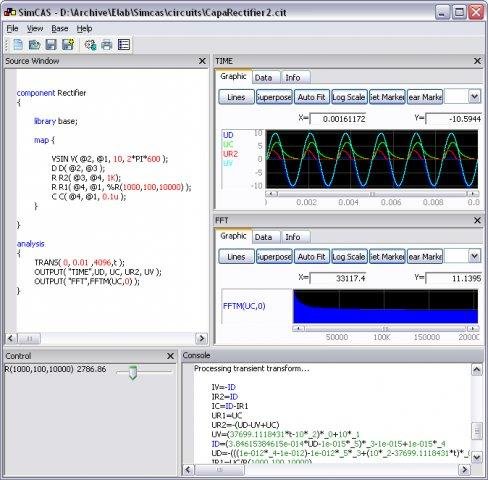
SimCAS symbolic analog simulator

Simcas is a simple and very flexible analog simulator. SimCAS uses symbolic equations to define components and solves the net system by using a "Computer Algebra System" algorithm [read more at: SimCAS Web Site]

Related papers:

[1] K. Singhal and J. Vlach, "Symbolic analysis of analog and digital circuits," in IEEE Transactions on Circuits and Systems, vol. 24, no. 11, pp. 598-609, Nov 1977. doi: 10.1109/TCS.1977.1084282
[2] G. M. Wierzba, A. Srivastava, V. Joshi, K. V. Noren and J. A. Svoboda, "Sspice-a symbolic SPICE program for linear active circuits," Proceedings of the 32nd Midwest Symposium on Circuits and Systems,, Champaign, IL, 1989, pp. 1197-1201 vol.2. doi: 10.1109/MWSCAS.1989.102070
[3] G. G. E. Gielen, H. C. C. Walscharts and W. M. C. Sansen, "ISAAC: a symbolic simulator for analog integrated circuits," in IEEE Journal of Solid-State Circuits, vol. 24, no. 6, pp. 1587-1597, Dec 1989. doi: 10.1109/4.44994
[4] Rob A. Rutenbar; Georges G. E. Gielen; Brian A. Antao, Interactive AC Modeling and Characterization of Analog Circuits via Symbolic Analysis; Computer-Aided Design of Analog Integrated Circuits and Systems; Year: 2002; Pages: 287 - 312, DOI: 10.1109/9780470544310.ch23
[5] G. Fontana; F. Grasso; A. Luchetta; S. Manetti; M. C. Piccirilli; A. Reatti; A new simulation program for analog circuits using symbolic analysis techniques; 2015 International Conference on Synthesis, Modeling, Analysis and Simulation Methods and Applications to Circuit Design (SMACD); Year: 2015; Pages: 1 - 4, DOI: 10.1109/SMACD.2015.7301682

[paper] 400 fJ Per-Cycle Frequency Reference for IoT

A 400 fJ Per-Cycle Frequency Reference for Internet of Things
Mathieu Coustans, François Krummenacher, Christian Terrier and Maher Kayal
IEL, École Polytechnique Fédérale de Lausanne, Switzerland

Abstract—This work presents an ultra-low power oscillator designed to target different contexts, such as crystal-assisted time keeping, reference oscillator to optimize the always on domain of a microcontroller or wake-up timer. This oscillator enables ultra-low power operation in 180nm CMOS technology with EKV3 compact model; the core oscillator consumes 2.5 nW at room temperature, with a temperature stability of 14 ppm/°C [-40°C - 60°C] and 0.07 %/V supply sensitivity [read more...]