National School of Applied Sciences of Safi, Cadi Ayyad University, Marrakech (MA)
Nov 19, 2020
[paper] Compact Model for Power MOSFET
National School of Applied Sciences of Safi, Cadi Ayyad University, Marrakech (MA)
[paper] HEMT RF/Analog Performance
1 Department of Genie Electric and Electronics, Unit Research of Material and Renewable Energies, University Aboubek Belkaid, Tlemcen, Algeria
2 LAAAS Laboratory, University of Batna 2, Batna, Algeria
3 Center Exploitation Telecommunication Satellite– Bouchaoui-Alger, Algeria Space Agency, Algiers, Algeria
4 Center Exploitation Telecommunication Satellite– Oran-Alger, Algeria Space Agency, Algiers, Algeria
Nov 18, 2020
[paper] Verilog-A Ion Sensitive FET for pH Sensor
[ref] Sergio Martinoia, Giuseppe Massobrio, “A Behavioral Macromodel of the ISFET in SPICE,” Sensors and Actuators B, Vol. 62, pp. 182–189, 2000
Appendix A
// Verilog-A Code for ISFET [ref]
`include "constants.vams"
`include "disciplines.vams"
module ISFET(ref,gm,ph);
inout ref,gm,ph;
electrical ref,gm,ph;
real EPH;
real T;
electrical node;
// PARAMETERS FOR ISFET
parameter real NAv = 6.023E26; //Avogadros constant(1/MOLE)// ISFET geometrical parametersparameter real DIHP =0.1E-9;parameter real DOHP =0.3E-9;//ISFET electrochemical parametersparameter real KA = 15.8;parameter real KB = 63.1E-9;parameter real KN = 1E-10;parameter real Nsil = 3.0E+18;parameter real Nnit = 2.0E+18;parameter real Cbulk = 0.1;parameter real epso = 8.85E-12;parameter real epsihp = 32; //relative permittivity of the Inner Helmholtz layerparameter real epsohp = 32; //relative permittivity of the Outer Helmholtz layerparameter real epsw = 78.5; //relative permittivity of the bulk electrolyte solution//Reference-electrode electrochemical parametersparameter real Eabs = 4.7; //absolute potential of the standard hydrogen electrodeparameter real Erel = 0.2;parameter real Phim = 4.7; //work function of the metal back contactparameter real Philj = 1E-3; //liquid-junction potential difference between the refsolution and the electrolyteparameter real Chieo = 3E-3; //surface dipole potential
real sq;
real CH, CD, CEQ, CB;
real Eref;
analog begin
endT= $temperature;ET= (`P_Q /(`P_K * T));sq = sqrt(8*`P_EPS0*epsw*`P_K * T);CB = (NAv*Cbulk);CH = ((`P_EPS0*epsihp*epsohp) / (epsohp*DIHP + epsihp*DOHP));CD = (sq*ET*0.5)*sqrt(CB);CEQ = 1/(1/CD + 1/CH);V(ref,node) <+ Eabs - Phim - Erel + Chieo + Philj;Eref = V(ref,node);V(x)<+ log(KA*KB)+4.6*V(ph);V(y)<+ log(KA)+2.3*V(ph);V(gm,node) <+ (`P_Q / CEQ) * (Nsil * ((limexp(-2 * V(gm,node) * ET)– limexp(V(x))) / (limexp(-2 * V(gm,node) * ET) + limexp(V(y)) * limexp(-1 * V(gm,node)*ET) + limexp(V(x)))) + Nnit*((limexp(-1 * V(gm,node)*ET))/(limexp(-1* V(gm,node)*ET)+ (KN/KA) * limexp(V(y)))));
capacitor #(.c(CEQ)) Cq(node,gm);resistor #(.r(1G)) RP1(x,gnd);resistor #(.r(1G)) RP2(y,gnd);resistor #(.r(1k)) RPH(ph,gnd);
Nov 17, 2020
[paper] Editorial Special Section on ESSDERC
We hope you will enjoy reading these high-quality papers. Stay safe
FRANCOIS ANDRIEU, TPC Chair
CEA-Leti
Université Grenoble Alpes
38054 Grenoble, France
GIOVANNI GHIONE, Editor-in-Chief
Dipartimento di Elettronica e Telecomunicazioni
Politecnico di Torino
10129 Torino, Italy
- Generalized Constant Current Method for Determining MOSFET Threshold Voltage M. Bucher, N. Makris, and L. Chevas pp.4559
- Performance and Low-Frequency Noise of 22-nm FDSOI Down to 4.2 K for Cryogenic Applications (Invited Paper) B. Cardoso Paz, M. Cassé, C. Theodorou, G. Ghibaudo, T. Kammler, L. Pirro, M. Vinet, S. de Franceschi, T. Meunier, and F. Gaillard pp.4563
- A Method for Series-Resistance-Immune Extraction of Low-Frequency Noise Parameters in Nanoscale MOSFETs A. Tataridou, G. Ghibaudo, and C. Theodorou pp.4568
- Analytical Model for Interface Traps-Dependent Back Bias Capability and Variability in Ultrathin Body and Box FDSOI MOSFETs W. Chen, L. Cai, X. Liu, and G. Du pp.4573
- Polarization Independent Band Gaps in CMOS Back-End-of-Line for Monolithic High-Q MEMS Resonator Confinement R. Hudeczek and P. Baumgartner pp.4578
- Out-of-Equilibrium Body Potential Measurement on Silicon-on-Insulator With Deposited Metal Contacts M. Alepidis, A. Bouchard, C. Delacour, M. Bawedin, and I. Ionica pp.4582
- Evaluation of High-Temperature High-Frequency GaN-Based LC-Oscillator Components A. Ottaviani, P. Palacios, T. Zweipfennig, M. Alomari, C. Beckmann, D. Bierbüsse, J. Wieben, J. Ehrler, H. Kalisch, R. Negra, A. Vescan, and J. N. Burghartz pp.4587
- Analysis of Gate-Metal Resistance in CMOS-Compatible RF GaN HEMTs R. Y. ElKashlan, R. Rodriguez, S. Yadav, A. Khaled, U. Peralagu, A. Alian, N. Waldron, M. Zhao, P. Wambacq, B. Parvais, and N. Collaert pp.4592
- Characterization and TCAD Modeling of Mixed-Mode Stress Induced by Impact Ionization in Scaled SiGe HBTs N. Zagni, F. M. Puglisi, G. Verzellesi, and P. Pavan pp.4597
- Hot-Electron Effects in AlGaN/GaN HEMTs Under Semi-ON DC Stress A. Minetto, B. Deutschmann, N. Modolo, A. Nardo, M. Meneghini, E. Zanoni, L. Sayadi, G. Prechtl, S. Sicre, and O. Häberlen pp.4602
- Vertically Replaceable Memory Block Architecture for Stacked DRAM Systems by Wafer-on-Wafer (WOW) Technology S. Sugatani, N. Chujo, K. Sakui, H. Ryoson, T. Nakamura, and T. Ohba pp.4606
- Reliability of Logic-in-Memory Circuits in Resistive Memory Arrays T. Zanotti, C. Zambelli, F. M. Puglisi, V. Milo, E. Pérez, M. K. Mahadevaiah, O. G. Ossorio, C. Wenger, P. Pavan, P. Olivo, and D. Ielmini pp.4611
- IGZO-Based Compute Cell for Analog In-Memory Computing—DTCO Analysis to Enable Ultralow-Power AI at Edge D. Saito, J. Doevenspeck, S. Cosemans, H. Oh, M. Perumkunnil, I. A. Papistas, A. Belmonte, N. Rassoul, R. Delhougne, G. Kar, P. Debacker, A. Mallik, D. Verkest, and M. H. Na pp.4616
- Array-Level Programming of 3-Bit per Cell Resistive Memory and Its Application for Deep Neural Network Inference Y. Luo, X. Han, Z. Ye, H. Barnaby, J.-s. Seo, and S. Yu pp.4621
- Ultrahigh-Density 3-D Vertical RRAM With Stacked Junctionless Nanowires for In-Memory-Computing Applications M. Ezzadeen, D. Bosch, B. Giraud, S. Barraud, J.-P. Noël, D. Lattard, J. Lacord, J. M. Portal, and F. Andrieu pp.4626
- Thermal Stress-Aware CMOS–SRAM Partitioning in Sequential 3-D Technology S. M. Salahuddin, E. Dentoni Litta, A. Gupta, R. Ritzenthaler, M. Schaekers, J.-L. Everaert, H. Yu, A. Vandooren, J. Ryckaert, M.-H. Na, and A. Spessot pp.4631
- Cryogenic Operation of Thin-Film FDSOI nMOS Transistors: The Effect of Back Bias on Drain Current and Transconductance M. Cassé, B. Cardoso Paz, G. Ghibaudo, T. Poiroux, S. Barraud, M. Vinet, S. de Franceschi, T. Meunier, and F. Gaillard pp.4636
- Enhanced Ultraviolet Avalanche Photodiode With 640-nm-Thin Silicon Body Based on SOI Technology I. Sabri Alirezaei, N. Andre, and D. Flandre pp.4641
- TCAD Study of VLD Termination in Large-Area Power Devices Featuring a DLC Passivation L. Balestra, S. Reggiani, A. Gnudi, E. Gnani, J. Dobrzynska, and J. Vobecký pp.4645
- Analysis of MIS-HEMT Device Edge Behavior for GaN Technology Using New Differential Method R. Kom Kammeugne, C. Leroux, J. Cluzel, L. Vauche, C. Le Royer, R. Gwoziecki, J. Biscarrat, F. Gaillard, M. Charles, E. Bano, and G. Ghibaudo pp.4649
- Influence of Substrate Resistivity on Porous Silicon Small-Signal RF Properties G. Godet, E. Augendre, J. Lugo-Alvarez, H. Jacquinot, F. X. Gaillard, T. Lorne, E. Rolland, T. Taris, and F. Servant pp.4654
- Free Carrier Mobility, Series Resistance, and Threshold Voltage Extraction in Junction FETs N. Makris, M. Bucher, L. Chevas, F. Jazaeri, and J.-M. Sallese pp.4658
- Local Variability Evaluation on Effective Channel Length Extracted With Shift-and-Ratio Method J. P. Martinez Brito and S. Bampi pp.4662
- Charge-Based Model for the Drain-Current Variability in Organic Thin-Film Transistors Due to Carrier-Number and Correlated-Mobility Fluctuation A. Nikolaou, G. Darbandy, J. Leise, J. Pruefer, J. W. Borchert, M. Geiger, H. Klauk, B. Iniguez, and A. Kloes pp.4667
- Macromodel for AC and Transient Simulations of Organic Thin-Film Transistor Circuits Including Nonquasistatic Effects J. Leise, J. Pruefer, A. Nikolaou, G. Darbandy, H. Klauk, B. Iniguez, and A. Kloes pp.4672
- Compact Modeling and Behavioral Simulation of an Optomechanical Sensor in Verilog-A H. Elmi Dawale, L. Sibeud, S. Regord, G. Jourdan, S. Hentz, and F. Badets pp.4677
- TCAD Simulation Framework of Gas Desorption in CNT FET NO2 Sensors S. Carapezzi, S. Reggiani, E. Gnani, and A. Gnudi pp.4682
- Conductance in a Nanoribbon of Topologically Insulating MoS2 in the 1T Phase V. Sverdlov, A.-M. B. El-Sayed, H. Kosina, and S. Selberherr pp.4687
- Vt Extraction Methodologies Influence Process Induced Vt Variability: Does This Fact Still Hold for Advanced Technology Nodes? M. S. Bhoir, T. Chiarella, J. Mitard, N. Horiguchi, and N. R. Mohapatra pp.4691
- Multidomain Negative Capacitance Effect in P(VDF-TrFE) Ferroelectric Capacitor and Passive Voltage Amplification K. J. Singh, A. Bulusu, and S. Dasgupta pp.4696
- Monte Carlo Comparison of n-Type and p-Type Nanosheets With FinFETs: Effect of the Number of Sheets F. M. Bufler, D. Jang, G. Hellings, G. Eneman, P. Matagne, A. Spessot, and M. H. Na pp.4701
- Impact of Width Scaling and Parasitic Series Resistance on the Performance of Silicene Nanoribbon MOSFETs M. Poljak pp.4705
[book] Emerging Trends in Terahertz Solid-State Physics and Devices by Springer Nature https://t.co/d6ic3XhucH. https://t.co/gaEUA16nMZ #semi https://t.co/N1Gve7JdIy
[book] Emerging Trends in Terahertz Solid-State Physics and Devices by Springer Nature https://t.co/d6ic3XhucH. https://t.co/gaEUA16nMZ #semi pic.twitter.com/N1Gve7JdIy
— Wladek Grabinski (@wladek60) November 17, 2020
from Twitter https://twitter.com/wladek60
November 17, 2020 at 03:59PM
via IFTTT
Fwd: Webinar on Material Growth, Characterization of Semiconductors and Device Applications Through Atomistic TNL TCAD
We, Tech Next Lab jointly with IEEE are organizing online Webinar on Material Growth, Characterization of Semiconductors and Device Applications Through Atomistic TNL TCAD. You may register on below given link and forward webinar link to other participants who are interested:
Date: Saturday, 21st November 2020 Time: 17.00 to 18.00 PM
We are pleased to introduce unmatched family of Innovative Atomistic TNL TCAD simulators, including EpiGrow, FullBand, HallMobility and Monte Carlo Particle Device simulators. All products are proprietary products of Tech Next Lab (P) Ltd. We provide instant technical and sales solution for the queries and feedback come from the customers. You may find more details about TNL TCAD tools on our website: www.technextlab.com You may download TNL TCAD from our website and ask us for evaluation license. Feel Free to write us your technical and sales related queries, we will revert to you with in next working day.
Looking forward to meeting you.
Best Regards,
TNL Framework: TNL Framework includes family of innovative simulators based on atomistic level. It provides innovative technology solution to semiconductor industry. The technology development is expensive process and suffers with lot of technical challenges & issues. TNL framework is designed to innovate the semiconductor device designing. It accomodate atomistic based thin film growth simulator, full band simulator, material characterization simulator and Monte Carlo particle device simulator.
EpiGrow Simulator: EpiGrow simulator is world's first commercial innovative atomistic epitaxial growth simulator to grow thin film inside MBE/MOCVD reactors. EpiGrow simulator is powerful tool to trace atomistic thin and thick film growth inside reactors. Kinetic Monte Carlo algorithms keeps Randomness in adsorption, hopping & desorption processes. It offer cost economical solution for thin film growth technology even for nm thin monolayer. Capable to predict the initial conditions for Molecular Beam Epitaxy & Molecular Organic Chemical Vapor Deposition (MOCVD) reactors. Capable to calculate the lattice constant of monolayer, trace different types of defects, and strain. Optimizer provides flexibility to optimize initial conditions with EpiGrow Simulator and run design of experiments over the computer.
FullBand Simulator: Full Band Simulator is powerful tool, extends the empirical pseudopotential method to include semiconductors with the zincblende as well as wurtzite structures and simulates electronic band structures with appropriate pseudopotential form factors chosen from the reported reputed references for binary alloy semiconductor materials and interpolate the pseudopotential form factors for ternary alloy semiconductor materials to simulate the full electronic band structures of ternary materials. The bowing of band energies and their deformation potentials is included inside simulator in form of alloy disorder. Capable to simulate the full electronic band structures for the lattice constant of monolayer provided by users. Different types of physical parameters e.g. carrier velocity, effective mass and density of states can be easily tracable on the full electronic band structures of the chosen materials. Provides flexibility to users to chose lattice constant and analyse the full electronic band structures over computer.
Hall Mobility Simulator: Hall Mobility Simulator is powerful tool, simulates carriers transport on full energy band. The microscopic simulation of the motion of individual particles in the presence of the forces acting on them due to external fields as well as the internal fields of the crystal lattice and other charges in the system. In solids, such as semiconductors and metals, transport is known to be dominated by random scattering events due to impurities, lattice vibrations, etc. has been inputted through Monte Carlo technique, which randomize the momentum and energy of charge particles in time. Hence, stochastic techniques to model these random scattering events are particularly useful in describing transport in semiconductors, in particular the Monte Carlo method. Provides flexibility to users to initialize the carriers over full energy band and analyze the transport of carrier to simulate the ensemble velocity of carriers under external electromagnetic forces on computer.
MC Particle Device Simulator: World's Fastest Monte Carlo Particle Device simulator includes transport model solution with a self -consistent Boltzmann-Poisson equation and a GUI based feature helps users to select device geometry and doping density in 2D and 3D. The different carrier scattering mechanisms has major influence on the performance of device output and dependent on the density of states (DOS) in each valley which can be accurately inputted through full band structure. The effect of equilibrium states of carrier before start of free flight of carrier has been incorporated in term of inclusion of depletion region through movement of the ensemble of carriers under influence of external electrostatic field obtained by solving the Poisson equation. The quantum confinement effect includes density gradient approach and effective potential approach for computation of quantum confinement effects on the carrier transport under influence of external forces. Particle Device Simulator (PDS) is exploited for unipolar as well as bipolar semiconductor technologies based devices including MOSFET, Multigate FETS, HEMT and P-N junction devices.
*******************************************
Dr. P. K. Saxena
CEO & CTO,
Tech Next Lab Pvt Ltd (TNL)
Near Nagar Nigam Office Zone-6,
Niwaz Ganj, Lucknow- 226 003 (INDIA)
Phone: (+91) 983 915 1284 / (+91) 9415893655
Fax: 0522 2258921
Email: info@technextlab.com
Web: www.technextlab.com
Skype ID: praveen.itbhu
Linkedin: https://www.linkedin.com/home?trk=nav_responsive_tab_home
********************************************
Nov 16, 2020
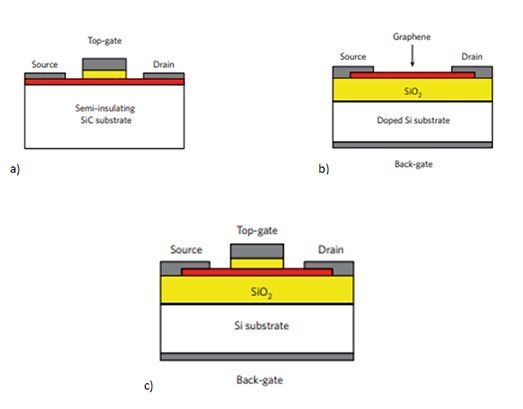
What Is a Graphene Field Effect Transistor (#GFET)?
What Is a Graphene Field Effect Transistor (#GFET)? Construction, Benefits, and Challenges - Technical Articles https://t.co/lTzuC59m5j #semi
— Wladek Grabinski (@wladek60) November 16, 2020
from Twitter https://twitter.com/wladek60
November 16, 2020 at 10:21AM
via IFTTT