Nov 27, 2023

Chips JU Launch Event


https://www.chipsjulaunchevent.eu/

Agenda Day 1: Embracing the voice of stakeholders
12:00 - 14:30 Registration
13:00 - 15:30 Networking lunch and exhibition "Walk of Fame" opening and guided tour
15:30 - 15:40 Welcome and opening, Jari Kinaret, Executive Director of the Chips JU
15.40 - 16:00 Keynote speech, Thierry Breton, European Commissioner for Internal Market
16:00 - 16:20 Intro speeches "EU strategic autonomy and economic security"
  Nikolai Setzer, CEO, Continental AG
  Jaime Martorell, Special Commissioner for Microelectronics and Semiconductors, Spain
16:20 - 17:20 1st Panel discussion with a moderator
  Thomas Skordas, DDG, CNECT, European Commission
  Pierre Barnabé, CEO, Soitec
  Roger Dassen, CFO, ASML
  Luc Van den hove, President and CEO, imec
  Frédérique Le Grévès, President & CEO, STMicroelectronics France
  Cinzia Silvestri, CEO, Bi/ond
  Alain Jarre, Chairman and CEO, RECIF Technologies
17:20 - 17:40 Coffee break
17:40 - 18:00 Intro speeches "Maintaining and boosting European technology leadership"
  Jochen Hanebeck, CEO, Infineon Technologies AG
  Jo Brouns, Flemish Minister for Economy, Innovation, Work, Social Economy, and Agriculture
18:00 - 19:00 2nd Panel discussion with a moderator
  Signe Ratso, Deputy Director-General, DG RTD, European Commission
  European Semiconductor Board Member (name tbc)
  Stefan Finkbeiner, CEO, Bosch Sensortec GmbH
  Maurice Geraets, Executive Director, NXP Semiconductors Netherlands B.V.
  Sébastien Dauvé, CEO, CEA-Leti
  Eva Maydell, Member of the European Parliament
  Joost van Kuijk, CEO/CMO, Adimec
19:00 - 19:05 Closing remarks by the moderator
19:15 Shuttle bus to the social event venue
20:00 - 22:30 Social event and walking dinner “Art & History Museum of Belgium”

Day 2 Part 1: Presentation of the Initiative
08:00 - 09:00 Registration & welcome coffee
09:00 - 09:10 Intro speech by Lucilla Sioli, Director DG CNECT.A, European Commission
09:10 - 09:40 New advanced pilot lines:
Yves Gigase, Head of Programmes,
Anton Chichkov, Programme Officer, Chips JU
 
09:40 - 09:55 Network of competence centre: Yves Gigase, Head of Programmes, and Anton Chichkov, Programme Officer, Chips JU
09:55 - 10:10
  Cuting-edge quantum chips: Gustav Kalbe, acting Director DG CNECT C, and
  Christian Trefzger, Policy Officer, DG CNECT, European Commission
10:10 - 10:25 Chips Fund: EC, EIB, EIC joint presentation
10:25 - 10:55 Q&A
10:55 - 11:25 Coffee break, networking and exhibition
11:25 - 12:15 Interactive session on Advanced design platform:
Marco Ceccarelli and Matihew Xuereb, Policy Officers, DG CNECT, European Commission
12:15 - 13:40 Networking lunch.

Day 2 Part 2: Chips JU R&I Programme
13:40 - 13:50 Intro speech by Jean-Luc di Paola-Galloni,
Chair of the Chips JU Private Members Board
13:50 - 14:50 3rd Panel discussion with a moderator
  Lucilla Sioli, Director, DG CNECT.A, European Commission
  Michael Paulweber, Director Global ITS Research & Technology, AVL List
  Régis Hamelin, CTO, Blumorpho
  Francis Balestra, Director of Research CNRS
  Ferdinand Bell, Head of Public Collaborative Programs,
NXP Semiconductors, Germany GmbH
  Christoph Kutier, Vice-Chair, Fraunhofer Microelectronics Group/FMD
  Bert de Jonge, CEO, VERUM
14:50 - 15:20 ECS SRIA 2024 – What is new? Patrick Cogez, Technical Director, AENEAS IA
15:20 - 15:50 Upcoming Chips JU calls and focus topics
  Yves Gigase, Head of Programmes, and
Anton Chichkov, Programme Officer, Chips JU
15:50 - 16:00 Closing remarks
Jari Kinaret, Executive Director of the Chips JU
16:00 - 17:30 Coffee break, networking and exhibition

Nov 21, 2023

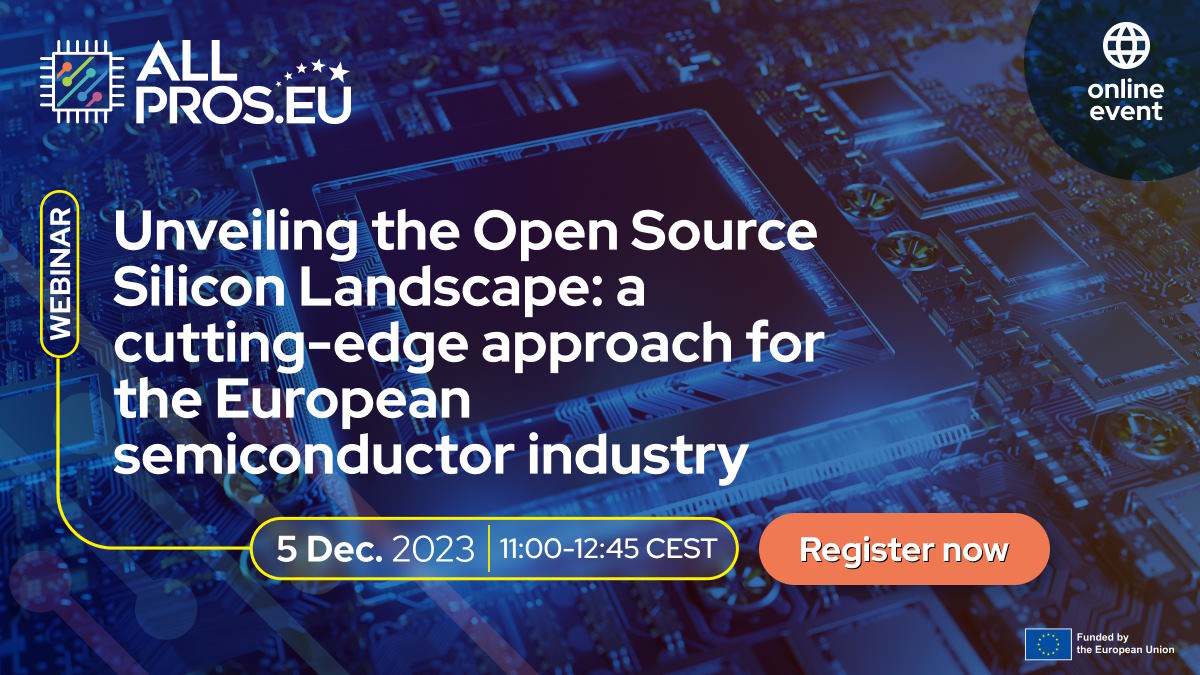
[webinar] Open Source Silicon Landscape

Unveiling the Open Source Silicon Landscape
a cutting-edge approach for the European semiconductor industry
5 December 2023


Who should attend and why:
  • Policymakers at the regional, national, and European level who want to strengthen their respective semiconductor ecosystem while collaborating and contributing to the Union’s industry as a whole
  • Research and academia representatives who are interested in deepening their knowledge or discovering the potential of the Open Source Silicon landscape
  • SMEs in the semiconductor industry who aim to expand and innovate their business by using a cutting-edge approach
  • Start-ups that are eager to elevate their business to the next level by embracing vanguard strategies
  • Citizen scientists and the general public who would like to have a better understanding of the new horizons in the semiconductor landscape
  • Experts active in industrial development who are interested in integrating potential new approaches
Registration:

The event is free of charge, but registration is mandatory. Registrants will receive the link to access the event by email.

Agenda:

11:00 - 11:05 Welcome
11:05 - 11:10 Introducing Open Source Silicon
11:10 - 11:20 BACKGROUND Open source silicon between software and hardware Background
11:20 - 11:40 POLICY BRIEF PRESENTATION Open source silicon’s position in the semiconductor value chain
11:40 - 12:35 PANEL Key opportunities and threats relevant to open source silicon strategies
12:35 - 12:45 Q&A and conclusions

Nov 20, 2023

[C4P] LAEDC 2024

CALL FOR PAPERS & POSTERS


LAEDC 2024 R&D topics of interest include, but are not limited to:
  • All electron-based devices
  • Electron Devices for Quantum Computing
  • RF-MMW-5G
  • Semiconductor-, MEMS- and Nanotechnologies
  • Packaging, 3D integration
  • Sensors and actuators
  • Display technology
  • Modeling and simulation
  • Reliability and yield
  • Device characterization
  • Reliability
  • Agrivoltaics

  • Flexible electronics
  • Biomedical Devices
  • Circuit-device interaction
  • Novel materials and process modules
  • Technology roadmaps
  • Electron device engineering education
  • Electron device outreach
  • Optoelectronics, photovoltaic and photonic devices and systems
  • Humanitarian Projects
  • STEM Initiatives
  • Energy harvesting
  • 2D Materials and Devices
IMPORTANT DATES:
  • Paper submission deadline: January 15, February 19, 2024
  • Author notification: April 1, 2024
  • LAEDC Conference Dates: MAY 8-10 2024
SPECIAL SESSIONS:
  • MOS-AK Workshop
  • IEEE EDS MQ
  • LAEDC Summer School
  • IEEE WIE/YP Session
  • Humanitarian Technology Session
ABOUT GUATEMALA:
Guatemala, country of Central America. The dominance of an Indigenous culture within its interior uplands distinguishes Guatemala from its Central American neighbours. The origin of the name Guatemala is Indigenous, but its derivation and meaning are undetermined. Some hold that the original form was Quauhtemallan (indicating an Aztec rather than a Mayan origin), meaning “land of trees,” and others hold that it is derived from Guhatezmalha, meaning “mountain of vomiting water” - referring no doubt to such volcanic eruptions as the one that destroyed Santiago de los Caballeros de Guatemala (now Antigua Guatemala), the first permanent Spanish capital of the region’s captaincy general. The country’s contemporary capital, Guatemala City, is a major metropolitan centre. Quetzaltenango, in the western highlands, is the nucleus of the Indigenous population.


Nov 16, 2023

Chipsalliance Technology Update - Nov. 2023

November 9, 2023

Check out the presentations below, and watch the replay here

  • Project Open Se Cura (slides)
    Kenny Vassigh, Bangfei Pan, Cindy Liu, Kai Yick, Google, Michael Gielda, Antmicro, Brian Murray, Verisilicon
  • Caliptra Workgroup Update (slides)
    Andres Lagar-Cavilla, Google
  • Enabling UVM testbenches in Verilator (slides)
    Michael Gielda, Karol Gugala, Antmicro
  • FuseSOC: Package manager and build abstraction tool for FPGA/ASIC development (slides)
    Olof Kindgren, Qamcom
  • CHIPYard: An Open Source RISC-V Design Framework (slides)
    Sagar Karandikar, U.C. Berkeley

Watch the Replay

Nov 14, 2023

[paper] Boropheneand Metal Interface

Vaishnavi Vishnubhotla, Sanchali Mitra, and Santanu Mahapatraa
First-principles based study of 8-Pmmn boropheneand metal interface
J. Appl. Phys. 134, 034301 (2023); doi: 10.1063/5.0144328
DOI 10.1063/5.0144328

Nano-Scale Device Research Laboratory, Department of Electronic Systems Engineering, 
Indian Institute of Science (IISc) Bangalore, India

Abstract: Borophene, the lightest member of mono-elemental 2D materials family, has attracted much attention due to its intriguing polymorphism. Among many polymorphs, digitally discovered 8-Pmmn stands out owing to its unique tilted-Dirac fermions. However, the property of interfaces between 8-Pmmn and metal substrates has so far remained unexplored, which has critical importance of its application in any electronic devices. Here, with the help of density functional theory, we show that the unique tilted-Dirac property is completely lost when 8-Pmmn borophene is interfaced with common electrode materials such as Au, Ag, and Ti. This is attributed to the high chemical reactivity of borophene as observed from crystal orbital Hamilton population and electron localization function analysis. In an effort to restore the Dirac property, we insert a graphene/hexagonal-boron-nitride (hBN) layer between 8-Pmmn and metal, a technique used in recent experiments for other 2D materials. We show that while the insertion of graphene successfully restores the Dirac nature for all three metals, hBN fails to do so while interfacing with Ti. The quantum chemical insights presented in this work may aid in to access the Dirac properties of 8-Pmmn in experiments.
FIG: (a) Top and side views of 3 × 3 × 1 supercell of 8-Pmmn borophene. The lattice parameters are a = 3.26 Å, b = 4.52 Å, and h = 2.19 Å. The inner and ridge atoms are denoted by blue and green atoms, respectively. (b) Crystal orbital Hamilton population (COHP) analysis and (c) electron localization function (ELF) plot for graphene and 8-Pmmn borophene.

Acknowledgments: The authors acknowledge the Supercomputer Education and Research Center (SERC), Indian Institute of Science (IISc), Bangalore, for CPU- and GPU-based computations. The computational charges were aided by the Mathematical Research Impact Centric Support (MATRICS) scheme of Science and Engineering Research Board (SERB), Government of India, under Grant No. MTR/2019/000047.